Bacillus Citrus
One microbe, five donor genomes
Context
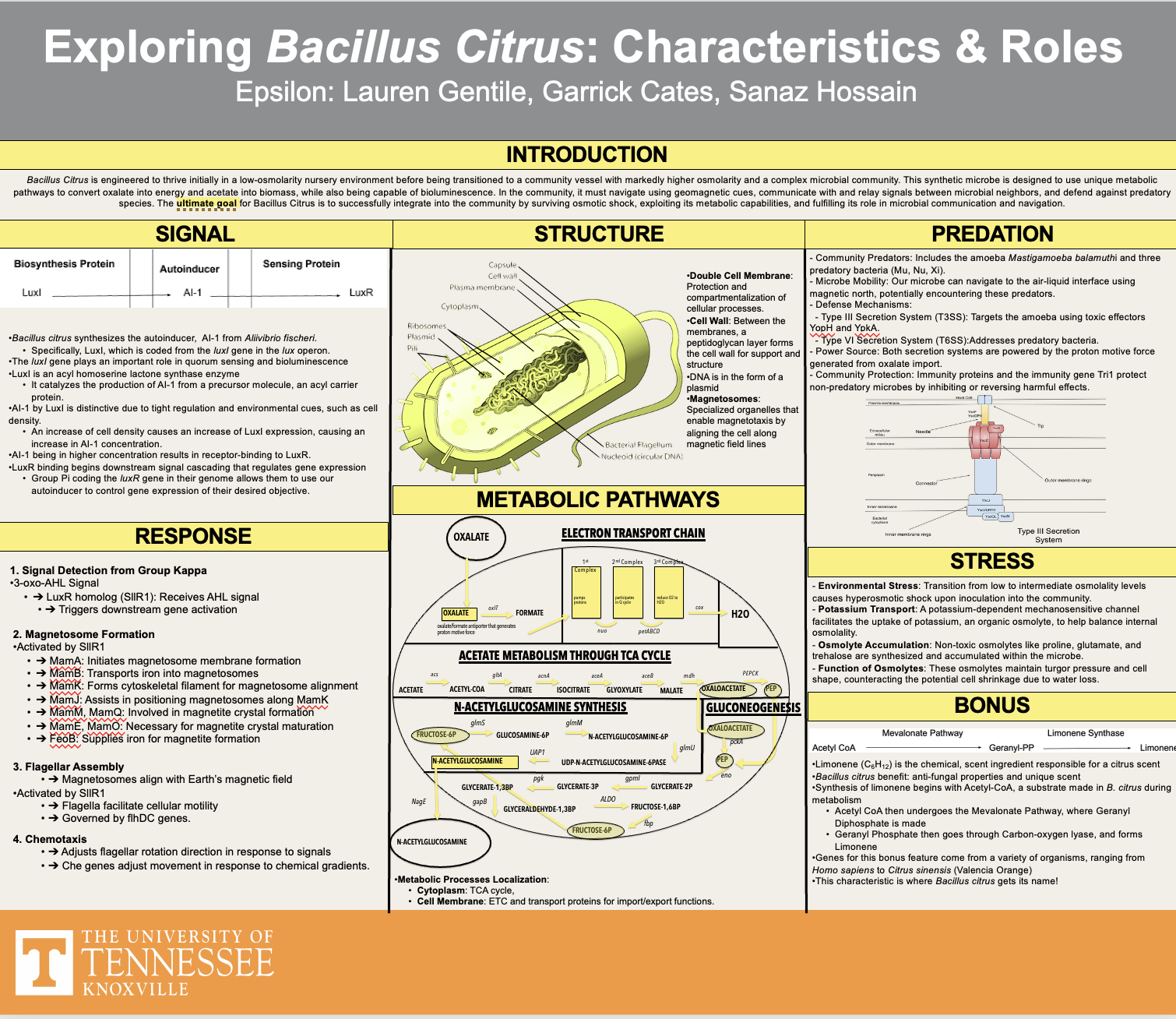
The team's project designed a synthetic microbe, Bacillus citrus, engineered to survive one specific transition: starting in a low-osmolarity “nursery” environment, then moving into a shared microbial community vessel with much higher osmolarity and a complex mix of competing microbes. To survive and function there, the microbe needed to metabolize oxalate for energy and acetate for biomass, communicate with neighbouring microbes via quorum sensing, navigate using magnetic field cues, and defend itself against predatory species already present.
Question
Can one synthetic organism be engineered to survive osmotic shock, metabolize an unconventional energy source, communicate with its community, navigate environmentally and defend itself — all at once, using genetic parts borrowed from unrelated organisms?
Approach & rationale
The design combines genetic parts from multiple organisms into one proposed genome: quorum-sensing genes (LuxI/LuxR family, from Aliivibrio fischeri, paired with a receptor from Ruegeria pomeroyi) to detect cell density; magnetosome-formation genes from magnetotactic bacteria like Magnetospirillum magneticum to build organelles that align the cell with Earth's magnetic field; flagellar and chemotaxis genes for motility and gradient-sensing; oxalate/acetate metabolic pathways feeding an electron transport chain for energy; osmolyte and potassium-transport systems for surviving the osmotic shock; and secretion systems for defense.
Methodology & iteration
The gene-part registry behind the design catalogues roughly 128 gene and part entries — spanning signal detection, magnetosome formation, flagellar assembly, chemotaxis, outer-membrane structure, peptidoglycan synthesis and ribosomal machinery — each tagged with its source organism (E. coli, Aliivibrio fischeri, Ruegeria pomeroyi, Magnetospirillum magneticum, plus Homo sapiens and Citrus sinensis for a limonene-synthesis pathway) and its proposed genomic location.
In short
The deliverable was the design itself: a complete proposed genetic circuit, backed by the gene-part registry, presented as a poster.
Results
The deliverable was the design itself: a complete proposed genetic circuit, backed by the gene-part registry, presented as a poster. No wet-lab implementation or experimental validation was part of this project — this was a design exercise, not an experimental one.
Significance
Presented as a team poster, "Exploring Bacillus Citrus: Characteristics & Roles," University of Tennessee, Knoxville.
Reflection